

…


创新是引领发展的第一动力,是建设现代化经济体系的战略支撑。党的十八大以来,大众创业、万众创新持续向更大范围、更高层次和更深程度推进,紧紧抓住科技创新这个“牛鼻子”,坚持以科技创新为引擎,释放科技创新新红利,增添经济发展新动能,推动经济高质量发展。
自2019年4月1日起施行的《中央企业负责人经营业绩考核办法》,提出对于中央企业负责人的考核要以突出创新驱动为导向,对科技进步要求高的企业,重点关注自主创新能力的提升,加强研发投入、科技成果产出和转化等指标的考核,对科技创新取得重大成果、承担重大专项任务和社会参与做出突出贡献的企业,在年度经营业绩考核中给予加分奖励。
2020年起中央企业经营业绩考核将新增营收利润率、研发(R&D)经费投入强度指标,形成“两利三率”指标体系,引导企业更好实现高质量发展。
随着税务信息化建设的不断深入,依托大数据与云计算技术,实现税务部门和相关部门联网的全面覆盖,转变了税收征管方式,出台了一系列工作规范,加大信息管税和风险管理力度,企业将面对更加严格的税收征管、一方面通过多维度指标开展纳税评估,评估指标影响信用等级的评定,同时直接影响企业能否享受税收优惠,而税务机关通过大数据分析核实税收优惠相关数据的真实性。
近年来,为积极响应国家号召,各居民企业均加大了科研投入力度,研发费用金额逐年增加,但根据目前统计分析的财务数据显示,研发费用占利润总额比重持续增长,与企业自身的科研成果不相匹配的现象普遍存在。
大多数企业内部研发管理流程不规范,研发行为较为孤立,没有一套完善的研发管理流程提供保障,缺乏相匹配的组织机制、业务流程、考核激励机制、监督执行机制,导致研发管理薄弱。
通过全方位、全角色的梳理研发管理流程,分析现有流程中存在的风险与漏洞,提升研发管理理念,建立和健全研发管理体系,优化研发结构与流程管控,完善考核指标与机制,形成相关部门高效协作的全流程研发管理工作指引,协助企业高效管理研发活动,降低管理风险,提高经营考核指标,合理合法享受税收优惠。
协助企业梳理现有的研发管理流程,分析现有流程中存在的风险与漏洞,形成研发管理风险分析报告,提升管理层研发管理理念,建立规范的研发管理体系。
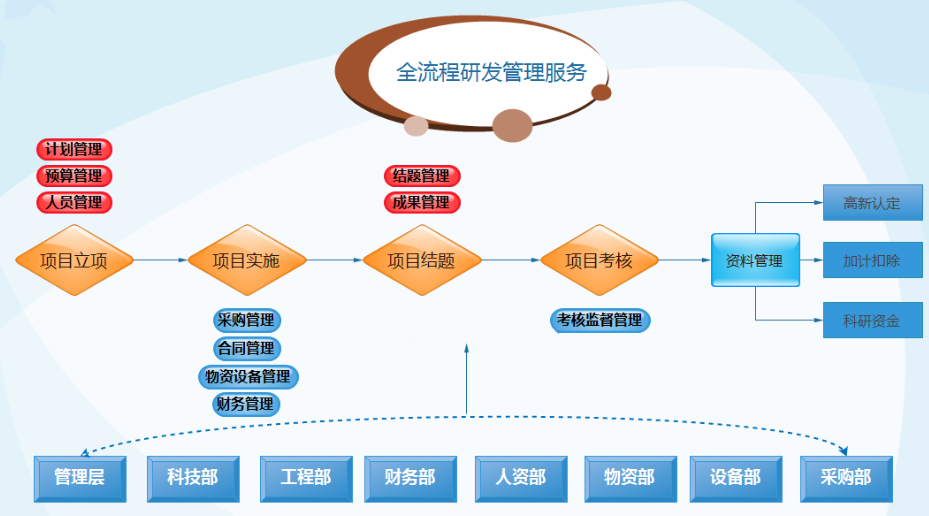
协助企业从项目立项、项目实施、项目结题、项目考核四大阶段建立和完善研发管理流程,加强研发过程管控。
协助企业建立由管理层、科技部、工程部、财务部、人资部、采购部、物资部、设备部等部门组成的角色明确、定位清晰的研发管理架构体系。
协助企业从计划管理、预算管理、人员管理、采购管理、合同管理、物资设备管理、财务管理、成果管理、申报管理、考核监督管理等方面明确岗位职责及工作流程,建立相关规章制度。
最终形成一套全方位、全流程、全角色的研发管理工作指引并进行相关培训。
可选服务:研发管理协作平台
提供定制化信息化支持,开发研发管理协作平台,利用信息化手段协助企业实现研发全方位、全流程、全角色的管理,提升科技研发管理效率,降低科技研发管理成本,并形成相应的成果资料,合理享受与研发费用相关的税收优惠(高新认定、加计扣除、科研项目科技资金申请等),推动企业持续创新发展。
研发管理协作平台以信息技术为支撑,从项目立项、项目实施、项目结题到项目考核及资料管理的全过程,对研发项目过程中涉及的计划、预算、人员、采购、物资设备、财务、结题、成果、项目资料等各阶段的研发活动提供流程化、标准化的的信息管控和服务,推动研发项目的可视化、数据化管理。
建立健全研发管理体系,规范研发管理流程,全流程把控规避相关风险。
利用政策规定打开创效渠道,加强研究开发项目的有效实施和管理,提高研发创新能力,提高考核指标达成率,提升经营业绩,合理合规享受国家税收优惠。
提升信息化建设水平,提高各部门工作效率,节省时间与管理成本。
结合企业自身特点,量身定制研发管理流程,推动研发管理高效开展。
以经验丰富的行业资深人员,组建专家服务团队,打造品质服务的坚实堡垒。
近年来,天扬为多家大型央企集团及其下属企业提供全流程研发管理服务,有效的协助企业规范研发项目相关管理工作。
专业的技术团队,利用信息化手段实现研发全流程、全角色、全方位管理。
Innovation is the primary driving force for development and a strategic pillar for building a modern economic system. Since the 18th National Congress of the Communist Party of China, mass entrepreneurship and innovation have been continuously advancing to a broader scope, higher levels, and deeper degrees. We have firmly grasped the "key point" of scientific and technological innovation, adhered to scientific and technological innovation as the engine, released new dividends from scientific and technological innovation, added new impetus to economic development, and promoted high-quality economic growth.
The "Measures for the Performance Evaluation of Central Enterprise Leaders" that came into effect on April 1, 2019, proposes that the assessment of central enterprise leaders should focus on promoting innovation-driven development. For enterprises with high demands for technological progress, the emphasis should be placed on enhancing their independent innovation capabilities. The assessment of indicators such as research and development investment, technological outcome production and transformation should be strengthened. For enterprises that have achieved significant results in scientific and technological innovation, undertaken major special tasks, and made outstanding contributions in social participation, they will be given bonus rewards in the annual performance evaluation of business operations.
Starting from 2020, the performance assessment of central enterprises will include indicators such as revenue profit rate and R&D (Research and Development) expenditure intensity, forming a "two profits and three rates" indicator system, which will guide enterprises to better achieve high-quality development.
With the continuous deepening of tax informatization construction, relying on big data and cloud computing technologies, a comprehensive network connection has been achieved between the tax department and relevant departments, transforming the tax collection and management methods. A series of work norms have been introduced, and efforts have been made to enhance information-based tax collection and risk management. Enterprises will face more stringent tax collection and management. On one hand, tax assessment will be conducted through multiple dimensions of indicators, and the assessment indicators will affect the credit rating assessment, while also directly influencing whether enterprises can enjoy tax benefits. Meanwhile, the tax authorities will verify the authenticity of tax benefit-related data through big data analysis.
In recent years, in response to the national call, all resident enterprises have significantly increased their investment in research and development. The amount of research and development expenses has been increasing year by year. However, according to the current statistical and analytical financial data, the proportion of research and development expenses in the total profit has continued to rise, and the phenomenon where it does not match the enterprises' own research achievements is widespread.
Most enterprises have an unstandardized internal R&D management process, and their R&D activities are rather isolated. There is no complete R&D management process to provide support, and there is a lack of corresponding organizational mechanisms, business processes, assessment and incentive mechanisms, and supervision and execution mechanisms, resulting in weak R&D management.
By comprehensively and systematically reviewing the R&D management process, analyzing the risks and loopholes existing in the current process, enhancing the R&D management concept, establishing and improving the R&D management system, optimizing the R&D structure and process control, perfecting the assessment indicators and mechanisms, and formulating a full-process R&D management guideline for relevant departments to achieve efficient collaboration throughout the entire process of R&D management, this helps enterprises manage R&D activities efficiently, reduce management risks, improve business assessment indicators, and legally enjoy tax benefits.
Assist enterprises in organizing their existing R&D management processes, analyze the risks and loopholes present in the current processes, formulate a R&D management risk analysis report, enhance the R&D management concepts of the management team, and establish a standardized R&D management system.
Assist enterprises in establishing and improving the R&D management process throughout the four stages of project initiation, project implementation, project conclusion, and project assessment, and strengthen the control of the R&D process.
Assist enterprises in establishing a clear and well-defined R&D management framework consisting of departments such as the management team, technology department, engineering department, finance department, human resources department, purchasing department, materials department, and equipment department.
Assist enterprises in clearly defining job responsibilities and work processes in areas such as planning management, budget management, personnel management, procurement management, contract management, material and equipment management, financial management, outcome management, application management, and performance supervision and management. Establish relevant rules and regulations.
Finally, a comprehensive, end-to-end, and all-role-oriented research and development management guideline was formulated and relevant training was conducted.
Optional service: Research and Development Management Collaboration Platform
Provide customized information technology support, develop a research and development management collaboration platform, and utilize information technology to assist enterprises in achieving comprehensive, full-process, and all-role management of research and development, improving the efficiency of technology research and development management, reducing the cost of technology research and development management, and forming corresponding achievement materials. Reasonably enjoy tax benefits related to research and development expenses (such as high-tech certification, additional deductions, application for scientific research project technology funds, etc.), and promote the continuous innovation and development of enterprises.
The R&D management collaboration platform is supported by information technology. It covers the entire process from project initiation, project implementation, project conclusion to project assessment and data management, providing process-oriented and standardized information control and services for all stages of R&D activities such as planning, budgeting, personnel, procurement, materials and equipment, finance, conclusion, achievements, and project data, promoting the visualization and dataization management of R&D projects.
Establish and improve the R&D management system, standardize the R&D management process, and conduct full-process control to avoid related risks.
Utilize the policy provisions to open up channels for generating profits, strengthen the effective implementation and management of research and development projects, enhance the innovation capabilities in research and development, increase the achievement rate of assessment indicators, improve business performance, and reasonably and legally enjoy national tax benefits.
Enhance the level of information system construction, improve the work efficiency of each department, and save time and management costs.
Based on the characteristics of the enterprise itself, tailor the R&D management process specifically, and promote the efficient implementation of R&D management.
By assembling an expert service team composed of experienced industry veterans, we aim to build a solid fortress of quality services.
In recent years, Tianyang has provided full-process R&D management services for several large state-owned enterprise groups and their affiliated enterprises, effectively assisting these enterprises in standardizing the management of R&D projects.
A professional technical team utilizes information technology to achieve full-process, all-stakeholder and all-round management of the R&D activities.

© 2000–2026 天扬君合税务师事务所版权所有
© 2026 天扬君合财税服务集团 京ICP备12023997号-1
 微信公众号
微信公众号